 Sprelay API
Claude Fable 5 Price: Real API Costs, Token Rates, and Production Examples
If you searched for claude fable 5 price, here's what you need to know:
Claude Fable 5 costs $10 per million input tokens and $50 per million output tokens. However, your actual production cost depends on how many API calls your workflow needs, how much output each call generates, and whether you use features like prompt caching or batch processing.
This guide breaks down the official pricing, shows real usage data from our platform, and helps you estimate your actual monthly costs.
Last updated: November 12, 2026 | Source: Anthropic official pricing and Sprelay production logs
Quick Price Overview
| Usage Type | Price per Million Tokens |
|---|---|
| Standard input tokens | $10.00 |
| Standard output tokens | $50.00 |
| 5-minute cache write | $12.50 |
| 1-hour cache write | $20.00 |
| Cache read | $1.00 |
| Batch input tokens | $5.00 |
| Batch output tokens | $25.00 |
Key takeaway: Output tokens are 5× more expensive than input. Applications that generate long responses, detailed reports, or extended reasoning will spend more on output than input.
Real Production Example: Afternoon SEO Content Workflow
Here is real usage data from our own Claude Fable 5 test session on Sprelay on November 2, 2026:
Workflow details: - Task: SEO article research, outline generation, and content drafting - Time period: One afternoon (requests made between 2:00 PM and 5:00 PM) - Total API calls: 23 requests - Total tokens processed: 411,451 tokens - Total cost: $0.42
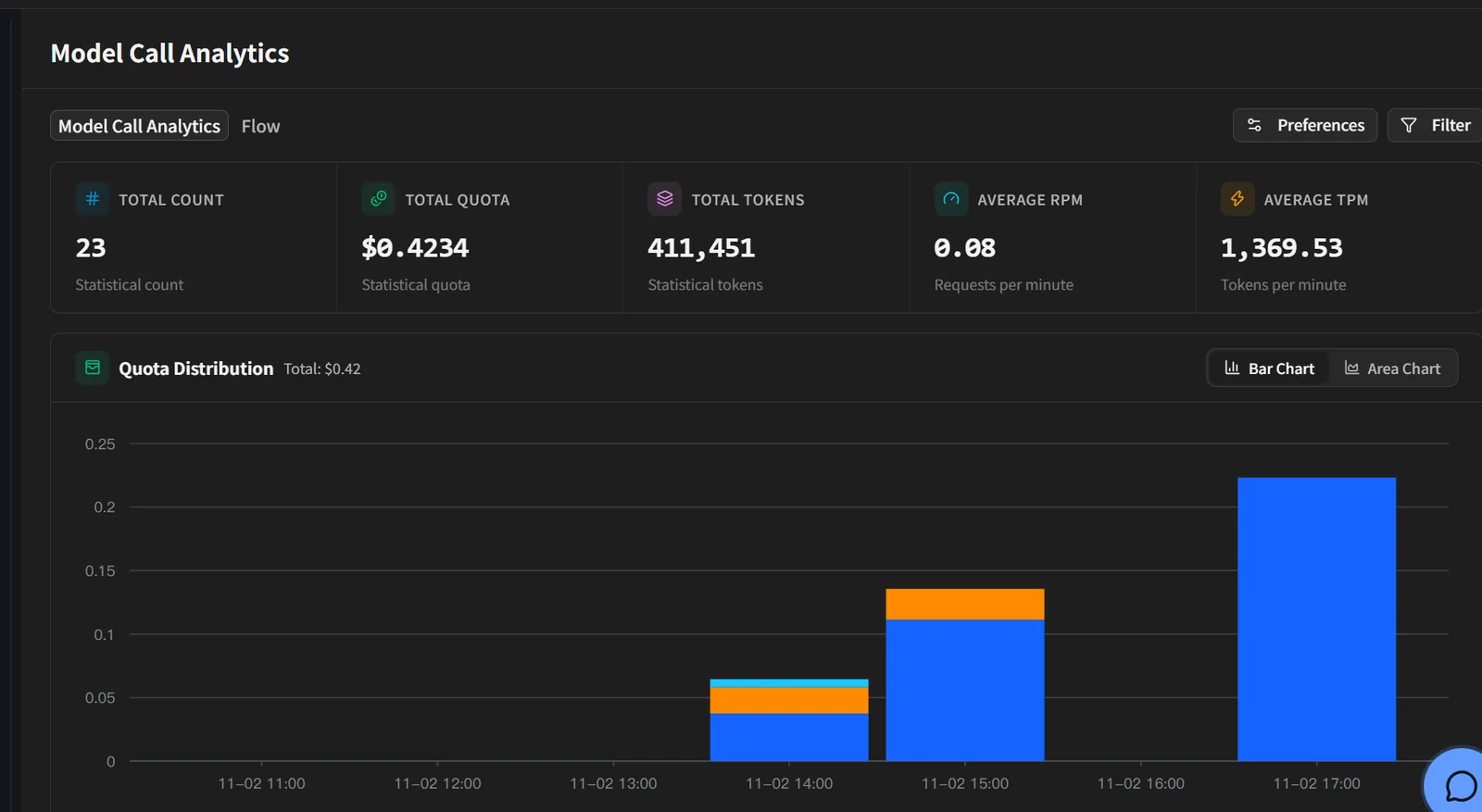
Sprelay usage dashboard for the Claude Fable 5 session on November 2, 2026: 23 requests, 411,451 tokens, $0.4234 total.
Cost breakdown: - Average cost per API call: $0.018 - Average tokens per call: ~17,890 tokens - Throughput: 1,369 tokens per minute average
What this tells us:
This workflow went through several rounds of keyword research, outlining, drafting, and revision. The whole session (23 API calls) cost $0.42.
Why did 411K tokens cost only $0.42? At Anthropic's standard rate, 411,451 input tokens alone would cost about $4.11. Two things brought the bill down:
- Sprelay's group pricing. Sprelay bills Claude Fable 5 below the official list price: $4 input / $20 output per million tokens on the Claude Code MAX group (0.4×), and $1.70 / $8.50 on the Claude Code kiro group (0.17×). See the full rate table below.
- Prompt caching. In a multi-round workflow, most of each request is the same context (instructions, research notes, earlier drafts) sent again. Those repeated tokens are billed at the cache-read rate, which is 10% of the input rate. Even at Sprelay's lowest uncached input rate, 411K tokens would cost about $0.70, so the $0.42 total means a large share of the tokens were cache reads.
Practical insight: Multi-step workflows with several API calls can still be very cost-effective. Don't just look at per-token rates—measure the cost per completed business task.
How Much Does Claude Fable 5 Cost per Request?
The cost per request depends on token usage, not just the number of calls. Here are typical scenarios:
| Scenario | Input Tokens | Output Tokens | Estimated Cost |
|---|---|---|---|
| Simple Q&A | 500 | 200 | $0.01 |
| Document summary | 5,000 | 800 | $0.09 |
| Code review | 15,000 | 3,000 | $0.30 |
| Long-form content | 3,000 | 8,000 | $0.43 |
| Multi-file analysis | 50,000 | 5,000 | $0.75 |
Formula:
Cost = (input_tokens ÷ 1,000,000 × $10) + (output_tokens ÷ 1,000,000 × $50)
For the most accurate estimates, use your API provider's actual token counts—different implementations may tokenize text slightly differently.
Monthly Cost Estimation
Your monthly budget depends on request volume and average token usage per task.
Example 1: Customer Support Bot
Assumptions: - 1,000 customer conversations per month - Average: 8,000 input + 1,500 output tokens per conversation - Standard API rates (no caching or batch processing)
Monthly cost calculation:
Input:  1,000 × (8,000 ÷ 1,000,000 × $10)  = $80
Output: 1,000 × (1,500 ÷ 1,000,000 × $50)  = $75
Total: $155/month
Cost per conversation: $0.155
Example 2: Daily Content Generation
Assumptions: - 50 articles per month - Average: 4,000 input + 6,000 output tokens per article - 3 API calls per article (outline, draft, polish)
Monthly cost calculation:
Total calls: 50 × 3 = 150
Input per article:  3 × (4,000 ÷ 1,000,000 × $10)  = $0.12
Output per article: 3 × (6,000 ÷ 1,000,000 × $50) = $0.90
Cost per article: $1.02
Monthly total: 50 × $1.02 = $51
Example 3: Code Analysis Pipeline
Assumptions: - 200 pull requests per month - Average: 25,000 input + 4,000 output tokens per PR - 2 API calls per PR (review + summary)
Monthly cost calculation:
Total calls: 200 × 2 = 400
Input per PR:  2 × (25,000 ÷ 1,000,000 × $10)  = $0.50
Output per PR: 2 × (4,000 ÷ 1,000,000 × $50)   = $0.40
Cost per PR: $0.90
Monthly total: 200 × $0.90 = $180
Budget planning tip: Add a 20-30% buffer for retries, error handling, longer-than-expected responses, and traffic spikes.
Can Prompt Caching Reduce Costs?
Prompt caching can significantly reduce costs for applications that reuse the same context repeatedly.
Claude Fable 5 Caching Rates
- 5-minute cache write: $12.50/MTok (25% premium over standard input)
- 1-hour cache write: $20/MTok (100% premium over standard input)
- Cache read: $1/MTok (90% discount vs. standard input)
When Caching Makes Sense
Caching is most effective when: - The same context (system prompt, documentation, codebase) is reused across many requests - The cached content is large (>10,000 tokens) - Requests occur within the cache lifetime - Cache reads significantly outnumber writes
Caching Cost Example
Scenario: Customer support bot with 30,000-token product documentation
Without caching (1,000 requests):
Input: 1,000 × (30,000 ÷ 1,000,000 × $10) = $300
With 1-hour caching:
Cache write: 1 × (30,000 ÷ 1,000,000 × $20)    = $0.60
Cache reads: 999 × (30,000 ÷ 1,000,000 × $1)   = $29.97
Total: $30.57
Savings: $269.43 (90% reduction)
Important: The cache write has a cost. If you only reuse context a few times, caching may not save money. Calculate the breakeven point before enabling it in production.
Batch API: 50% Cost Reduction for Async Work
Batch processing reduces standard rates by 50%:
- Batch input: $5/MTok (vs. $10 standard)
- Batch output: $25/MTok (vs. $50 standard)
When to Use Batch Processing
Batch API is designed for asynchronous workflows where immediate responses aren't required:
✅ Good use cases: - Nightly data processing - Document classification and tagging - Scheduled content generation - Large-scale summarization - Model evaluation and testing
❌ Not suitable for: - Live chatbots - Real-time customer support - Interactive applications - Any workflow requiring immediate response
Batch Cost Example
Scenario: Classify 10,000 support tickets overnight
Standard API:
Input:  10,000 × (2,000 ÷ 1,000,000 × $10) = $200
Output: 10,000 × (300 ÷ 1,000,000 × $50)  = $150
Total: $350
Batch API:
Input:  10,000 × (2,000 ÷ 1,000,000 × $5)  = $100
Output: 10,000 × (300 ÷ 1,000,000 × $25)  = $75
Total: $175
Savings: $175 (50% reduction)
Claude Fable 5 vs. Fable 5.1: Which Is Cheaper?
Claude Fable 5.1 has the same standard rates but a much lower cache-read price.
| Component | Fable 5 | Fable 5.1 | Difference |
|---|---|---|---|
| Input tokens | $10/MTok | $10/MTok | Same |
| Output tokens | $50/MTok | $50/MTok | Same |
| Cache reads | $1/MTok | $0.25/MTok | 75% cheaper |
When Fable 5.1 Saves Money
If your application heavily relies on cached context, Fable 5.1 can significantly reduce costs.
Example: 1,000 requests reading 30,000 cached tokens each
| Model | Cache read cost | Savings |
|---|---|---|
| Fable 5 | $30 | — |
| Fable 5.1 | $7.50 | $22.50 (75%) |
Decision factors beyond price: - Output quality and accuracy - Response latency - Context window size - API compatibility with your existing code
Get Claude Fable 5 Through Sprelay
Sprelay gives you pay-as-you-go access to the Claude Fable 5 API. The same API key also works with models from OpenAI, Google, DeepSeek, Moonshot, MiniMax, and other providers, so you can compare Claude Fable 5 with other models without managing a separate account for each provider.
- Pay-as-you-go billing: You pay only for the tokens you use. There is no subscription and no monthly minimum.
- Low entry point: You can start with a minimum top-up of $5.
- Payment options: Top up with PayPal or USDT.
- Usage analytics: Your dashboard shows request count, token usage, cost, RPM, and TPM, so you can track spend as it happens (see the real example above).
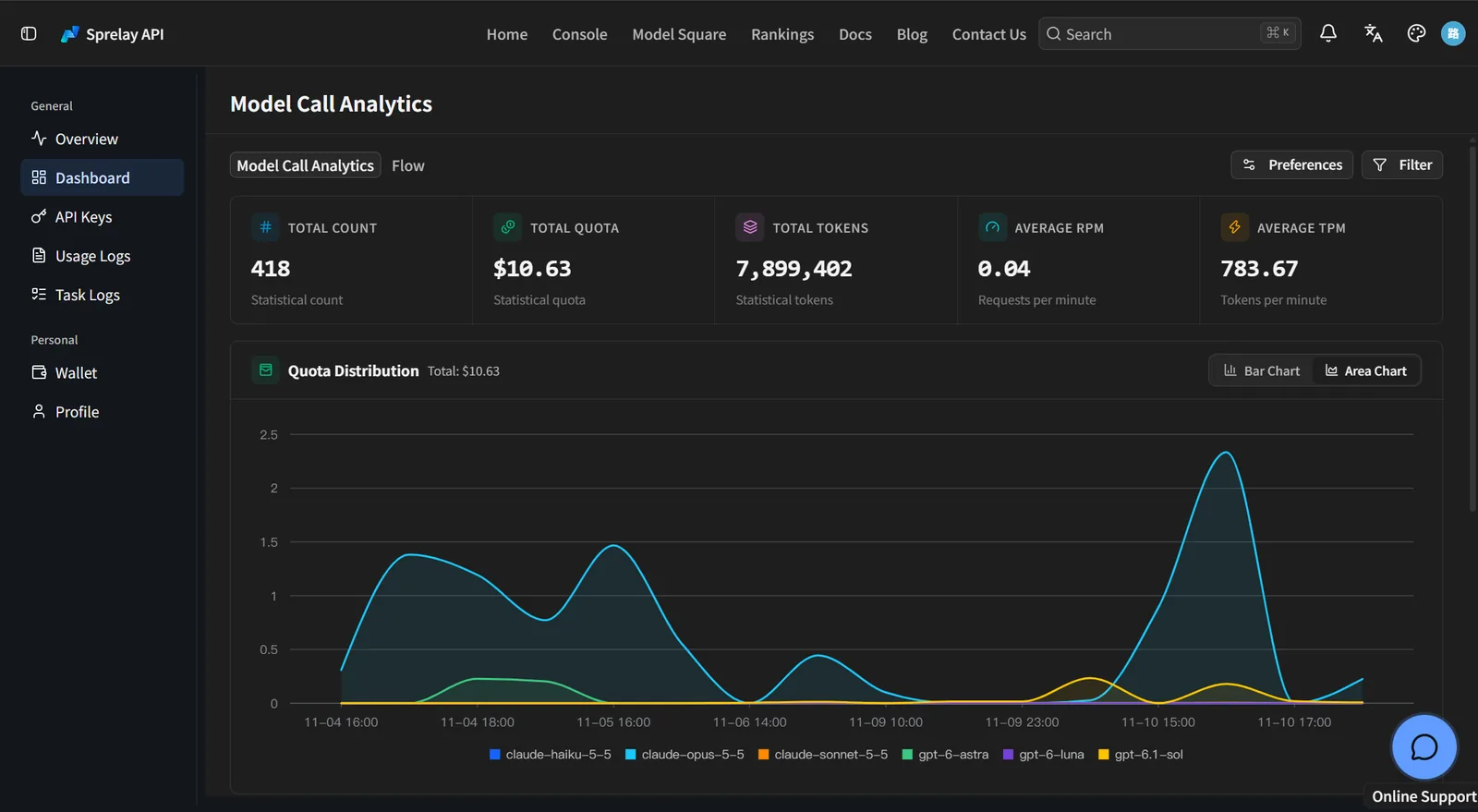
One week of our own usage on Sprelay (November 4 to 10, 2026) across several Claude and GPT models: 418 requests, about 7.9 million tokens, and $10.63 in total. The quota chart breaks spend down by model and by hour, so you can see which model drives your bill.
Sprelay Claude Fable 5 Rates
| Pricing (per 1M tokens) | Input | Output | Cache read | Cache write |
|---|---|---|---|---|
| Anthropic official | $10.00 | $50.00 | $1.00 | $12.50 |
| Sprelay – Claude Code MAX group (0.4×) | $4.00 | $20.00 | $0.40 | $5.00 |
| Sprelay – Claude Code kiro group (0.17×) | $1.70 | $8.50 | $0.17 | $2.125 |
Claude Fable 5.1 is also available on the Claude Code MAX group at $4 input / $20 output / $0.10 cache read / $1.50 cache write. See the Claude Fable 5.1 setup guide.
Rates are the public group prices listed on sprelaytoken.com/pricing/claude-fable-5 as of November 4, 2026. Check the pricing page for current rates before you budget.
Who Is Sprelay For?
- Developers who want to test cheaply: A $5 top-up is enough to run real workloads and measure your own cost per task before you commit a larger budget.
- Users who prefer PayPal or crypto: If PayPal or USDT is more convenient for you than the payment methods other providers accept, you can top up with either one.
- Teams that track spend closely: With per-request usage data, you can check your cost estimates against your actual bill.
→ Start using Claude Fable 5 → | View detailed pricing →
Frequently Asked Questions
What is the Claude Fable 5 price per 1,000 tokens?
- Input: $0.01 per 1,000 tokens
- Output: $0.05 per 1,000 tokens
Output tokens cost 5× more than input, so applications generating long responses will have higher costs.
Is Claude Fable 5 billed monthly or per-use?
Claude Fable 5 API uses pay-as-you-go pricing. You're billed based on actual token usage, not a fixed monthly subscription. Your monthly bill depends on how many tokens your application consumes.
Is Fable 5.1 cheaper than Fable 5?
Standard input and output rates are identical. Fable 5.1 is cheaper only if you use prompt caching heavily—cache reads cost 75% less ($0.25/MTok vs. $1/MTok).
What's the cheapest way to use Claude Fable 5?
The most cost-effective approach depends on your workload:
- For async tasks: Use batch API (50% discount)
- For repeated context: Enable prompt caching
- For all workloads: Optimize prompts to reduce output length and avoid unnecessary API calls
How do I estimate my real production cost?
- Run a representative sample of tasks (e.g., 50-100 requests)
- Measure average input and output tokens per completed task
- Count how many API calls each task requires (including retries)
- Calculate cost per task using the formula above
- Multiply by your expected monthly task volume
- Add a 20-30% buffer for edge cases and traffic spikes
How do I pay for Claude Fable 5 on Sprelay?
You can top up your Sprelay balance with PayPal or USDT, and the minimum top-up is $5. Usage is charged against your balance as you make requests. There is no monthly subscription.
What is the minimum amount needed to start?
You can start with $5. That is enough to run test workloads and measure your real cost per task before you scale up.
Do I need a Claude subscription to use the API?
No. Claude subscription plans (for claude.ai web/desktop access) and API access are separate products. API usage is billed based on token consumption, regardless of whether you have a Claude subscription.
Key Takeaways
- Standard pricing: $10/MTok input, $50/MTok output
- Output costs more: 5× more expensive than input—optimize response length
- Real-world example: Our afternoon SEO workflow on Sprelay cost $0.42 for 23 API calls processing 411K tokens
- Batch processing saves 50% for asynchronous workloads
- Prompt caching saves 90% on cache reads, but only when context is reused frequently
- Fable 5.1 is cheaper only if you use prompt caching heavily
- Measure task-level costs, not just per-token rates—multi-call workflows may still be very cost-effective
Ready to start? Create a Sprelay account →, top up from $5 with PayPal or USDT, and start calling Claude Fable 5 on a pay-as-you-go basis.
Official Resources
Need help estimating costs for your specific use case? Contact our team → or compare model rates on our pricing page →